Today, at 11:46 am, a new season arrived. The spring equinox, also known as the vernal equinox, is a welcome sign in the northern hemisphere because the earth is close enough to the sun allowing us to enjoy an equal number of daylight and nighttime hours. This is in contrast to the winter solstice on December 21 which gave us the longest and darkest night of the year.
I was wondering what happened to the weathergrams that were created on that evening by participants gathered for an event.
On that night, Melrose Community Church hosted a service called Christmas in a Minor Key and welcomed anyone in the community to join. Anyone who experienced loss—the loss of a loved one, a dream, a relationship, something equally vital or precious—was invited to gather for a service of reflection. For each one, the reason was unique.
A pianist shared a song he composed about personal loss. In silence, we lit candles, scribed keywords on stone, placed markers on a map, painted a small canvas, wrote a poem, and engaged in other reflective activities. We were together—but in some ways apart—in our silence. During a season when others were gathering for festive occasions, Christmas in a Minor Key provided a more solemn space for those who were looking for ways to cope or to hope.
At the activity station I hosted, participants were invited to craft a simple weathergram to hang outdoors—to watch it weather during the winter. Traditionally, they are hung on a balcony, in a backyard, a local park, or hiking trail—any place that is visited frequently. Then weathergrams are revisited on the spring equinox to see how they fared during winter. Did the messages survive in the places where they were placed or were they carried by the wind to other destinations to live their stories elsewhere? Were they resilient, did they remain intact, or did they succumb to the harshness of winter?
In our own loss, would we…be resilient, remain intact, succumb?
On the winter solstice, I created several weathergram messages—some expressing sorrow, some reflecting on hope. During the winter when I am prone to seasonal affective disorder, I could use hope…and light.
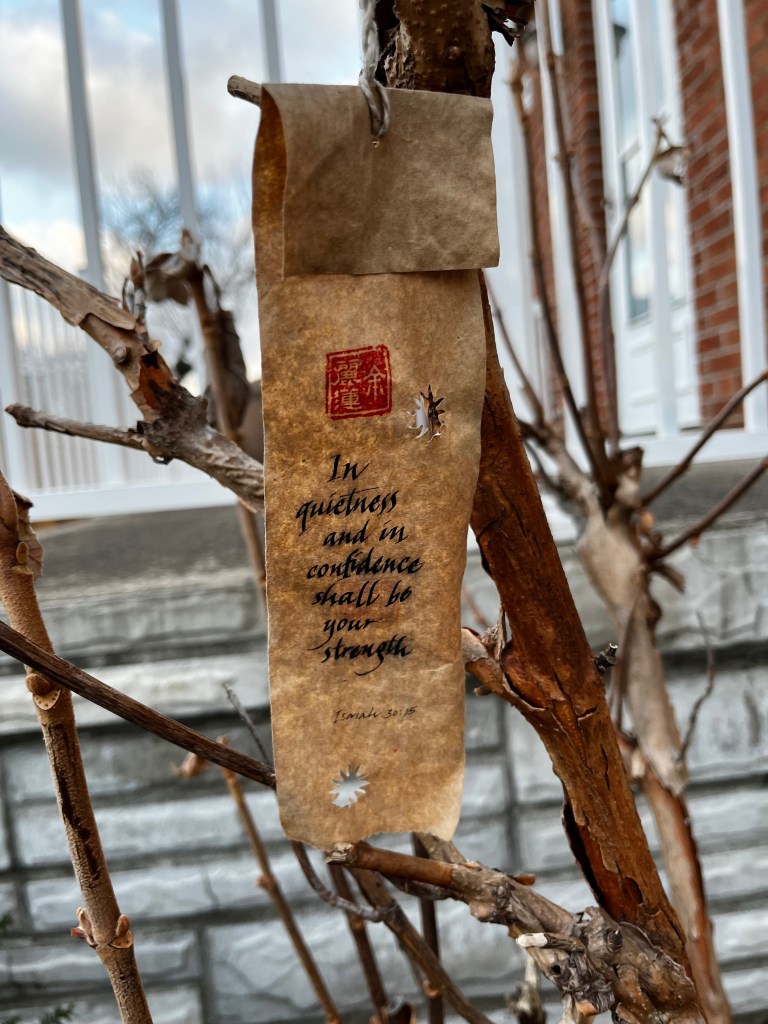
My husband and I tied the weathergrams around our property—on the back hedge, on the oak leaf hydrangea at the back porch, and on the large linden in the side yard. Today we wandered around the yard searching for the bookmark-sized messages. Only one weathergram remained, tenaciously clinging to the oak leaf hydrangea. Flapping in the fierce wind, it paused long enough for a photo. Since it was so resilient, we decided to leave it for another season as the hydrangea blooms in spring. Maybe we’ll leave it to enjoy the protective shade of summer and to be refreshed by the autumn rains. Might it be strong enough to survive until the winter solstice?
We’ll see.
More weathergram stories:
Weathergrams
Strength and Resilience
Weathering Winter
Nestergram
Weathering Spring
Chiming In
Heart of a Weathergram
Spring Equinox
 An Artist's Journey