Scribbled Lives Week 12—Folk Tales
As a child, one of my treasures was a cookie tin featuring the image of a young woman charging into battle on a white horse. My mother often told the story of Mulan, a heroine from fifth-century Chinese history. Every time I heard the story, I was inspired by her brave and honourable character.
When Disney made an animated film featuring Mulan in 1998, I was delighted that more people (especially girls) would hear her story. Disney produced a live action film in 2020, amending the plot line and deviating from the heart of the folk tale.
However, as a child, I was fascinated by the original legend.
Mulan’s elderly father, a war veteran in frail health, was being called into service again. The military was conscripting one man from each family to battle nomadic invaders. Her father was in no shape to enter battle. Against his wishes, but motivated to defend her family’s honour, Mulan takes his place—disguised as a man.
Her asset is not physical strength but war strategy. Following a decade of distinguished military service, Mulan is honoured by the Emperor. She declines a position of high office, choosing instead to return to her village. Reunited with family, she seeks to mend the relationship with her father, ultimately receiving his respect for her honourable and courageous actions.
I seem to recall there was a love story in there, but that part didn’t captivate my childhood fantasy…
Scholars disagree on whether Mulan was an historical person or a fictional character. Of course, in my childhood imagination she was very real!
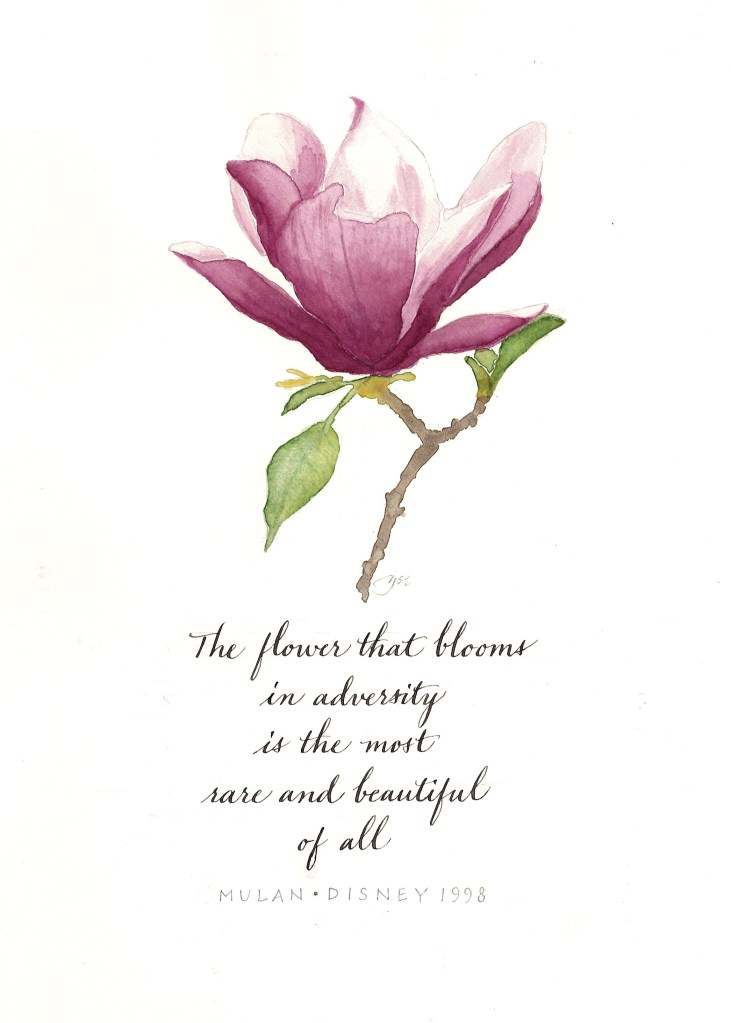
The Chinese characters representing Mulan’s name mean magnolia = wood (mu) + orchid (lan). Magnolias symbolize longevity, perseverance, and nobility.
Pointed pen, walnut ink, and watercolour on Fabriano 140# HP.
 An Artist's Journey